
A guide to choosing between light and heavy pipe: how furniture, industrial, scaffolding, galvanized and Mannesmann (seamless) pipe differ in price, weight, standard and use.
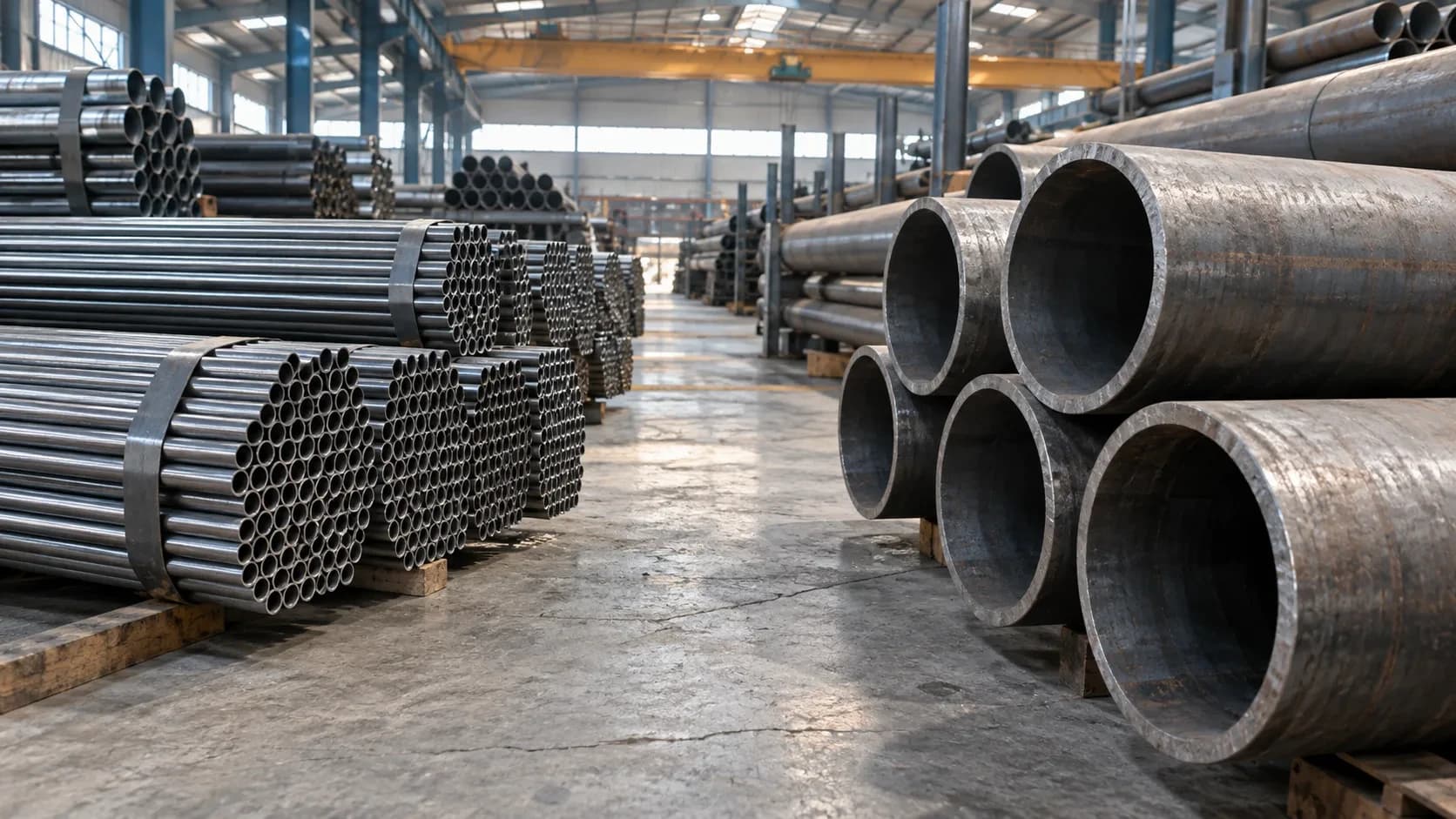
Light or heavy pipe; which is the better choice? The short answer is: for delicate parts, bending, and products where weight and appearance are important, light or furniture pipe is usually the more logical choice. For chassis, frames, and parts that bear greater loads, we generally turn to thicker industrial pipe. However, “light” and “heavy” are not the names of a single standard; before comparing prices, the pipe family, actual thickness, and application must be specified.
A common mistake is to look only at the price per kilogram. Light pipe may be more expensive per kilogram, but because its weight per meter is lower, the price per length and transportation cost may be lower.
First, what does “light or heavy pipe” mean?
In the Iranian market, the terms light and heavy are used in several different senses. These categories should not be substituted for one another without checking the technical specifications:
- Furniture or light pipe: A thin-walled, smooth-surfaced, precise pipe that is usually produced from oiled sheet and is used for furniture, automobiles, and formable parts.
- Welded industrial pipe: Usually made from hot-rolled or black sheet and used in various diameters and thicknesses for frames, chassis, and general industrial applications.
- Light and heavy scaffolding pipe: Their main difference is the weight of the length and the wall thickness. This pipe is not designed for fluid transmission.
- Light, medium, or heavy galvanized pipe: This term refers to the weight class of the same family and should not be considered synonymous with furniture pipe.
- Seamless pipe with different schedules: In this family, the nominal size and Schedule or schedule must be checked; the market terms light and heavy are not sufficient for a technical order.
Therefore, before answering the question “light or heavy pipe,” first specify the product family and its actual application.
Conclusion: “Industrial pipe” is not always synonymous with “heavy pipe,” and “light pipe” is not always synonymous with all thin-walled pipes on the market. The product name should be written alongside the standard, diameter, thickness, and application.
Light or heavy pipe; a comparison at a glance
| Purchasing criterion | Light or furniture pipe | Thicker industrial pipe |
|---|---|---|
| Common raw material | Cold-rolled oiled sheet | Hot-rolled black sheet |
| Common market thickness | Usually about ۰.۴ to ۱.۵ millimeters | Usually ۲ millimeters and more |
| Surface and precision | Smoother, suitable for painting and plating | Darker surface, suitable for industrial work |
| Weight per meter | Lower | Higher |
| Forming | Suitable for bending and controlled drawing | Depends on grade, thickness, and equipment |
| Main advantage | Precision, appearance, and weight reduction | Greater load-bearing capacity and rigidity |
| Typical application | Furniture, automobiles, bicycles, and household appliances | Chassis, equipment frames, and industrial structures |
| Risk of incorrect selection | Reduced strength under unsuitable loading | Unnecessary increase in weight and cost |
These thicknesses are common market practice, not definitive standard boundaries. Orders for sensitive projects must be placed exactly according to the drawing, grade, and standard.
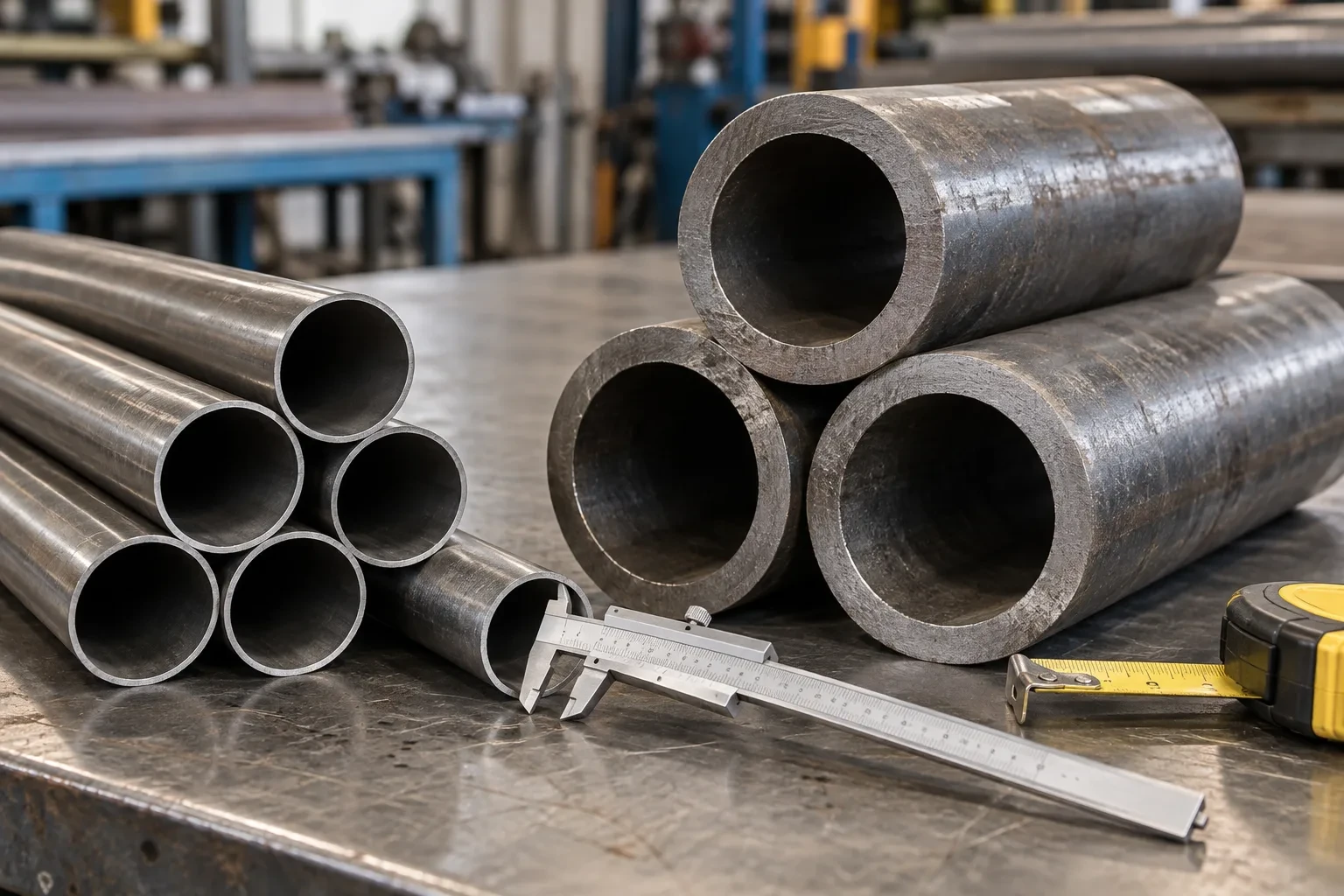
Visual comparison of the wall thickness of light and heavy pipes; the final selection must be made based on the project’s technical specifications.
What features does light or furniture pipe have exactly?
In the production of furniture pipe, surface appearance and dimensional control are highly important. For this reason, this product is mostly used where the part must be bent, painted or plated, or placed inside an assembly with limited tolerances. Standard EN 10305-3:2023 also covers cold-calibrated welded steel tubes for precision applications and identifies the automotive, furniture, and general engineering industries as common applications.
However, a thin wall alone is not a sign of quality. Uniformity of thickness, weld-line quality, surface smoothness, the absence of ovality in the cross-section, and the pipe’s behavior during bending are more important than the name “light.”
When is industrial and heavy pipe a more suitable choice?
When a part is expected to withstand greater loads, impacts, or vibrations, increasing the thickness can raise the rigidity and cross-sectional capacity. Industrial pipe is widely used in the construction of machinery bases, chassis, metal frames, guards, and workshop equipment. However, for water, gas, steam, or industrial-fluid lines, thickness alone is not a safety criterion; the seam type, material, production standard, design pressure and temperature, and product tests must be specified.
To review available products, you can visit the industrial pipe price page. When reviewing this page, read the product name, factory, size, and update date alongside the price, and inquire about the definitive rate and availability.
What does light and heavy mean in different pipe families?
| Pipe family | Correct comparison criterion | Purchasing note |
|---|---|---|
| Furniture and precision | Outside diameter, thickness, tolerance, and surface quality | Check forming, bending samples, and weld quality |
| Welded industrial | Diameter, thickness, weight, grade, and seam type | Structural application is not the same as fluid transmission |
| Scaffolding | Diameter, thickness, and actual length weight | Do not use for fluids; connection and the condition of the length are important |
| Galvanized | Weight class, base thickness, and coating type | Check application, threading, coating, and corrosive environment |
| Seamless | NPS/DN, Schedule, grade, and standard | The term light or heavy cannot replace the schedule and standard |
For example, standard ASME B36.10M standardizes the dimensions of welded and seamless steel pipes. Therefore, in engineered piping, it is better to write the exact nominal size and schedule instead of the ambiguous term “heavy.”
How is the price of light or heavy pipe compared?
For a real comparison, place four figures alongside one another: price per kilogram, weight per meter, length of the pipe, and the cost of services or transportation. The per-kilogram price of light pipe may be higher because of oiled sheet, production precision, and surface quality; however, its lower weight usually reduces the price per meter. In contrast, thicker pipe may have a lower per-kilogram rate but its length may cost more.
Approximate cost of each length = weight per meter × length of the pipe × price per kilogram
Add the costs of cutting, bending, plating, packaging, loading, tax, and transportation separately. If one seller gives a price per length and another gives a price per kilogram, do not compare the two offers without converting both to the same basis.
Example of calculating the weight of two pipes with the same diameter
The approximate weight of each meter of carbon steel pipe is obtained from the following relationship:
Weight per meter = ۰.۰۲۴۶۶ × thickness × (outside diameter − thickness)
Diameter and thickness in this relationship are in millimeters. For a six-meter length with an outside diameter of ۲۵ millimeters:
| Thickness | Approximate weight per meter | Weight of ۶-meter length |
|---|---|---|
| ۱ millimeter | ۰.۵۹ kilograms | ۳.۵۵ kilograms |
| ۲ millimeters | ۱.۱۳ kilograms | ۶.۸۱ kilograms |
If the per-kilogram rate is equal, the ۲-millimeter length will be approximately ۱.۹ times more expensive. This calculation is for an initial estimate; scale weight, thickness tolerance, weld seam, and coating may slightly change the actual result.
Examples from Ahantime’s market
At the time of review, Ahantime’s price pages for welded industrial pipe displayed products from Sepahan, Semnan, Sepanta, and Dorpad Tehran, and its galvanized pipe pages displayed products from Navard Loole Saveh, Tehran Shargh, Loole Semnan, Ahvaz Pipe Mill, and Kalup. These names are merely examples of the site’s available inventory and categorization; the best factory should be selected based on size, standard, availability, delivery location, and project requirements.
To compare other families, see the scaffolding pipe price and galvanized pipe price pages. Market prices are variable; check the update date and the “estimated” or “definitive” description before making a decision.
Which pipe is more suitable for each application?
| Project requirement | Initial choice | Reason |
|---|---|---|
| Furniture and metal chairs | Furniture pipe | Low weight, better surface, and formability |
| Automotive or bicycle parts | Precision pipe according to the drawing | Dimensional control and formability |
| Equipment base and frame | Industrial pipe | Greater rigidity and load-bearing capacity |
| Temporary scaffolding | Standard scaffolding pipe | Compatibility with clamps and safety requirements |
| Damp environment or greenhouse | Suitable galvanized pipe | Better resistance to corrosion |
| Pressurized line | Pipe with the required standard and design schedule | Pressure is not determined by the words light or heavy |
This table is a starting point, not a replacement for engineering design. If part failure could cause loss of life or serious damage, the specifications must be approved by a qualified person.
Light or heavy pipe purchasing checklist
- Write down the product’s exact application: structure, manufactured part, or fluid transmission.
- Specify the outside diameter or nominal size, thickness, and length of the pipe.
- Record the sheet type, grade, standard, and factory on the pro forma invoice.
- Obtain the per-kilogram price, length weight, and price per length simultaneously.
- Ask about dimensional tolerance, surface quality, and bending or welding conditions.
- Review cutting, plating, loading, tax, and transportation services separately.
- At delivery, weigh several lengths and check the thickness with a suitable tool.
- For sensitive orders, obtain the product certificate and required test results.
Four costly purchasing mistakes
- Choosing solely by the name light or heavy: These names are not sufficient without a thickness number and standard.
- Comparing prices on different bases: A per-kilogram price should not be directly compared with a per-length price.
- Replacing thickness without calculation: Reducing weight does not always mean economic efficiency and may reduce the part’s durability.
- Using an unsuitable pipe for structural or pressure applications: Similar appearance does not guarantee the same application.
Conclusion; is light or heavy better?
There is no permanent winner when choosing light or heavy pipe. Furniture pipe is more suitable for precision, appearance, bending, and weight reduction; thicker industrial pipe will be a more logical choice for many frames and heavily loaded parts. In scaffolding, galvanized, and seamless pipes, the definition used by that particular family must also be examined.
The right decision begins with five specifications: application, diameter, thickness, standard, and actual weight. After that, the per-kilogram and per-length prices can be placed on the same basis, and the option that is truly economical and safe for the project can be selected.
Frequently Asked Questions
آیا لوله سبک همان لوله مبلی است؟
در عرف بازار ایران معمولاً بله؛ اما هنگام سفارش باید ضخامت، نوع ورق و وزن هر شاخه نیز دقیق مشخص شود.
آیا قیمت لوله سبک از لوله سنگین کمتر است؟
قیمت هر شاخه لوله سبک معمولاً کمتر است، اما قیمت هر کیلوگرم آن بهدلیل ورق روغنی و دقت تولید میتواند بیشتر باشد.
چگونه لوله سبک و سنگین را تشخیص دهیم؟
مطمئنترین راه، بررسی قطر، ضخامت واقعی و وزن هر متر یا شاخه است؛ نام تجاری محصول بهتنهایی کافی نیست.
آیا میتوان لوله سنگین را با لوله سبک جایگزین کرد؟
در قطعات کمبار ممکن است، اما در سازه، شاسی یا تجهیزات تحت بار نباید بدون محاسبه مهندسی ضخامت را کاهش داد.
آیا هر لوله سنگین برای انتقال گاز یا آب مناسب است؟
خیر. برای انتقال سیال باید استاندارد، رده، نوع درز، آزمون تولید و فشار طراحی متناسب با پروژه بررسی شود.
Reader comments
Be the first to share your experience with this article.