
Get to know seamless (mannesmann) steel pipe — production method, applications, standards, Schedule, weight, the difference from welded pipe, and industrial buying tips.
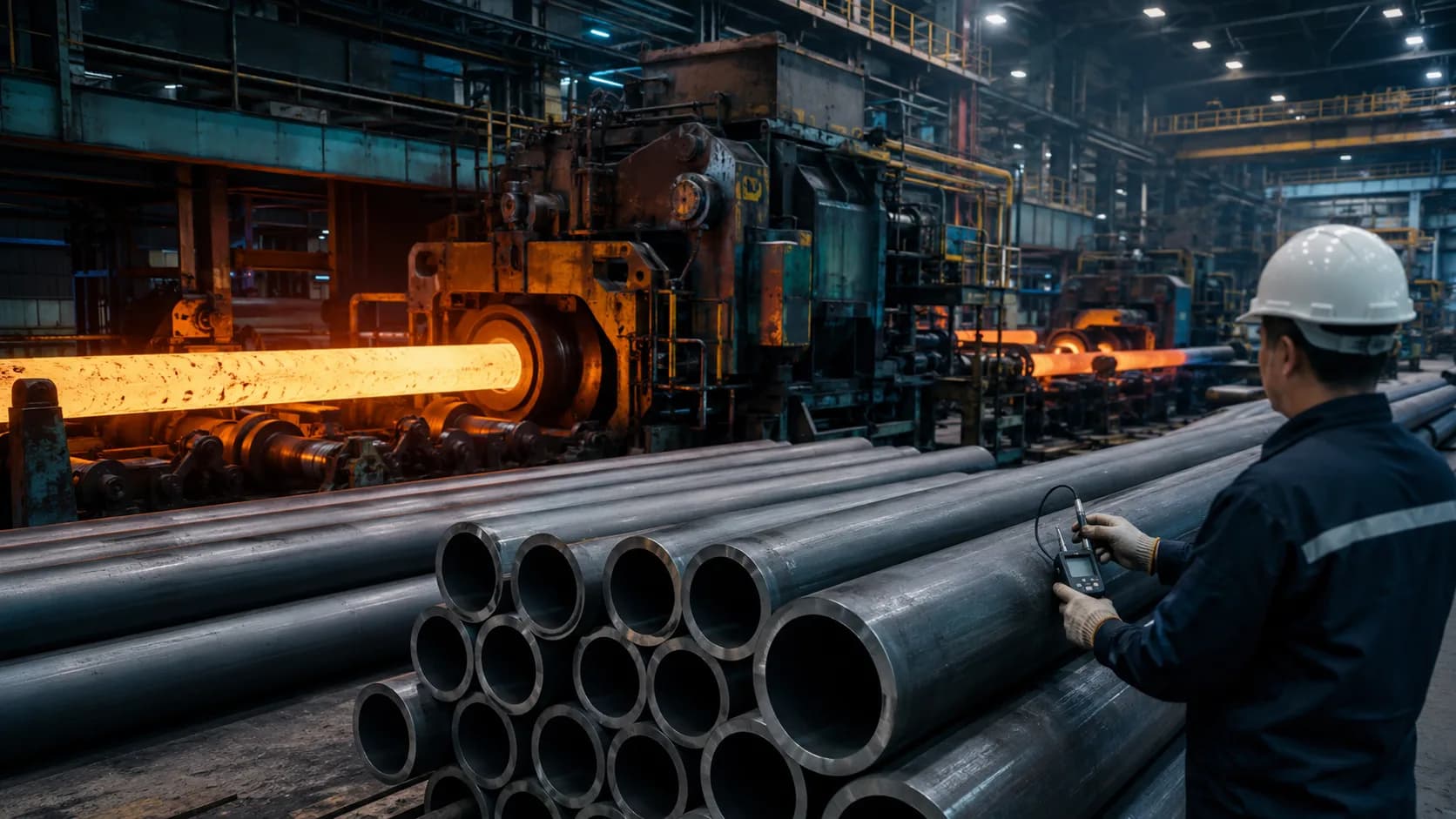
Short answer: Seamless or Mannesmann steel pipe is made from a solid steel billet and has no longitudinal weld line in its body. This pipe is selected for certain high-pressure and high-temperature services and sensitive applications; however, being seamless alone does not guarantee allowable pressure or product quality. The standard, grade, dimensions, service conditions and technical certificate must be assessed together.
How Is Seamless Steel Pipe Manufactured?
In the production of this pipe, the steel billet is heated and converted into a hollow shell through piercing and rolling. After diameter reduction or drawing, heat treatment, straightening, cutting and final inspection are carried out. For some products, mechanical, hydrostatic or nondestructive tests are also performed according to the product standard.
In the Iranian market, this product is commonly called “Mannesmann pipe.” This name only refers to the manufacturing method and does not replace the standard and grade.
Classification of Seamless Steel Pipe
For the right selection, do not identify the pipe only by the name Mannesmann. Its specifications consist of several sections:
| Classification basis | Groups | Importance in purchasing |
|---|---|---|
| Material | Carbon, low-alloy, alloy, stainless steel and duplex | Resistance, corrosion and operating temperature |
| Application | Process, oil and gas, boiler, heat exchanger, hydraulic and mechanical | Selection of the appropriate standard and tests |
| Schedule | Schedule، STD، XS and XXS | Thickness, weight and internal diameter |
| Finishing method | Hot-rolled, cold-drawn and precision pipe | Tolerance, surface and dimensional accuracy |
| End type | Plain, beveled, threaded or coupled | Connection to flanges and fittings |
For example, “A106 Grade B، NPS 2، Schedule 40” means that the product standard and grade, nominal size and dimensional Schedule have been specified. None of these expressions alone replaces the complete project specifications.
The Most Important Seamless Pipe Standards
| Standard | General application | Important note |
|---|---|---|
| ASTM A106/A106M | Seamless carbon steel for high-temperature service | The grade and design temperature must be checked. |
| ASTM A53/A53M | Welded or seamless steel pipe for general applications | Specify the product type and Grade. |
| API 5L | Line pipe for oil and gas transportation | PSL, grade and tests depend on the project. |
| ASTM A333/A333M | Low-temperature service | The design temperature and impact test are important. |
| ASME B36.10M | Dimensions and nominal thickness of steel pipe | A dimensional standard is not a quality certificate. |
The above standards should not be considered equivalent. A pipe may be similar to another product in terms of diameter and thickness but may not be interchangeable in terms of grade, testing or application.
How Should Size, Diameter and Schedule Be Read?
Nominal size or NPS is not the same as the actual diameter. For example, NPS 2 or “۲ inches” has an outside diameter of ۶۰٫۳ millimeters, not ۵۰٫۸ millimeters. The internal diameter also changes with thickness and is approximately obtained from the relation ID = OD − 2t.
| NPS | Outside diameter (mm) | Sample weight Sch 40 (kg/m) |
|---|---|---|
| ½ inches | ۲۱٫۳ | ۱٫۲۷ |
| ۱ inch | ۳۳٫۴ | ۲٫۵۰ |
| ۲ inches | ۶۰٫۳ | ۵٫۴۴ |
| ۳ inches | ۸۸٫۹ | ۱۱٫۲۹ |
| ۴ inches | ۱۱۴٫۳ | ۱۶٫۰۷ |
| ۶ inches | ۱۶۸٫۳ | ۲۸٫۲۶ |
| ۸ inches | ۲۱۹٫۱ | ۴۲٫۵۵ |
| ۱۲ inches | ۳۲۳٫۹ | ۷۹٫۷۳ |
Schedule is the dimensional designation. For a fixed size, a higher Schedule generally has a thicker wall, greater weight and smaller internal diameter. For example, NPS 2 pipe in Schedule 40 has a theoretical weight of approximately ۵٫۴۴ kilograms per meter, while in Schedule 80 it has a theoretical weight of ۷٫۴۸ kilograms per meter. These figures are approximate and may differ slightly from the actual factory or weighing-scale weight.
What Applications Are Seamless Pipes Suitable For?
Seamless pipes are used in process lines, steam and high-temperature services, power plant equipment, boilers, heat exchangers, hydraulic systems and some oil and gas lines. However, selection should start with the application, not the product name. Pressure, temperature, fluid type, corrosion and the design code determine which standard and grade are appropriate.
For some large diameters, welded pipe may be a more practical and economical option. The absence of a longitudinal weld line in seamless pipe is a structural characteristic, not a reason for absolute superiority in every project.
How Should Seamless Steel Pipe Be Purchased?
- Write down the service specifications: fluid type, pressure, temperature and corrosion conditions.
- Finalize the standard and grade: such as ASTM A106 Grade B or API 5L X52; do not substitute one for the other without project approval.
- State the dimensions completely: NPS or DN, outside diameter, thickness or Schedule and pipe length.
- Request the documents: material certificate, Heat Number, test report and inspection documents if required by the project.
- Clarify the transaction terms: new or used, imported or domestic, price unit, tax, transportation and validity date.
- Inspect upon delivery: match the marking, diameter, thickness, length, quantity and documents against the order.
To view the current price, visit the AhanTime pipe price page, and to estimate weight, use the pipe weight calculation tool. The price of each pipe cannot be compared without knowing its length, weight and technical specifications.
Conclusion
Seamless steel pipe is the right choice when the manufacturing method, standard, grade, dimensions and service conditions are aligned with the project requirements. In an inquiry, the phrase “Mannesmann pipe” is not sufficient; write the technical specifications and delivery documents precisely. This both makes price comparison more realistic and prevents the purchase of an unsuitable product.
Frequently Asked Questions
لوله فولادی بدون درز چیست؟
لولهای است که از شمش فولادی توپر و بدون خط جوش طولی تولید میشود. مناسببودن آن به استاندارد، گرید، ابعاد و شرایط سرویس بستگی دارد.
لوله مانیسمان برای چه کاربردهایی مناسب است؟
در خطوط و تجهیزات صنعتی، بخار، دمای بالا، فشار و برخی سرویسهای حساس؛ اما انتخاب باید با دیتاشیت و کد طراحی پروژه تطبیق داده شود.
Schedule 40 و Schedule 80 چه تفاوتی دارند؟
در یک سایز اسمی ثابت، Schedule 80 معمولاً ضخامت و وزن بیشتر و قطر داخلی کمتری از Schedule 40 دارد؛ فشار مجاز فقط از روی Schedule تعیین نمیشود.
آیا لوله بدون درز همیشه بهتر از لوله درزدار است؟
خیر. لوله درزدار استاندارد و کنترلشده در بسیاری از پروژهها انتخاب مناسبی است. معیار درست، شرایط سرویس، استاندارد، کیفیت جوش، گرید و مدارک محصول است.
برای خرید لوله بدون درز چه مدارکی لازم است؟
مشخصات فنی، استاندارد و گرید، ابعاد و ضخامت، گواهی متریال و گزارش آزمون یا بازرسی در صورت الزام پروژه باید بررسی و با سفارش تطبیق داده شود.
Reader comments
Be the first to share your experience with this article.